When to use AI or "hire" a human
A decision framework to help you decide when AI is actually cheaper than a human.
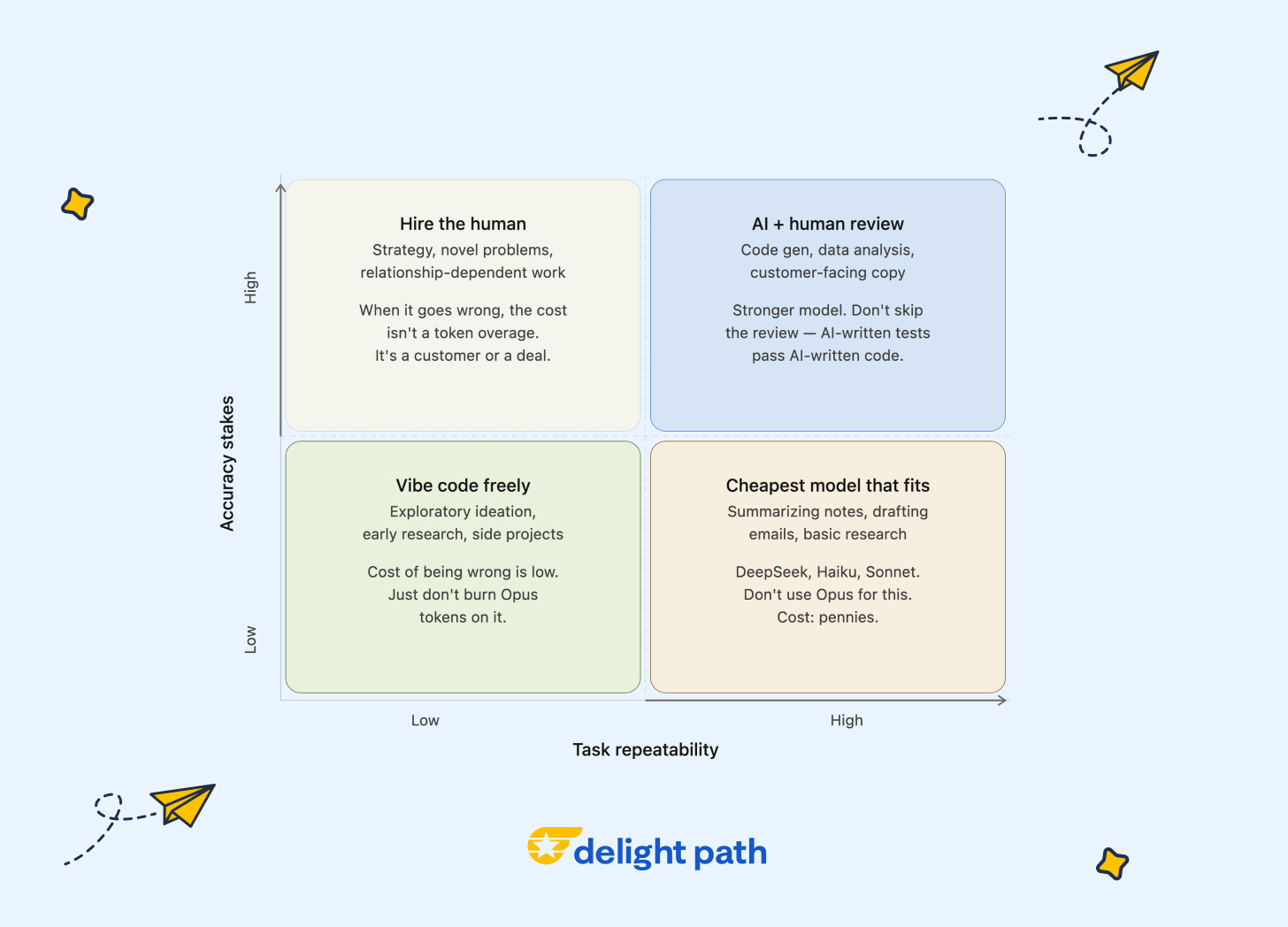
Table of contents
You're vibe coding with Claude. You're 45 minutes in, making real progress. Then: limit reached.
You wait. You switch to a cheaper model. It's slower, worse at your specific task. You switch back. More tokens burn. Five hours later, you've got something decent, but you've spent half the session managing the tool instead of doing the work.
AI was sold to us as a subscription. Pay $20 for all-you-can-eat. But it was never really that. It's a consumption model wearing a subscription costume.
One product team launched a new agent to 30 beta customers. Their AI bills went from $2 to $2,000 in a single month. No one predicted it. No one had modelled it. Their framing: "AI cost now looks less like a software margin and more like a restaurant business. If the fish gets expensive, I have to keep looking at my cost."
Anthropic's Fable is already 4-5x the cost of Opus. Uber hit their annual token limit in four months. Microsoft pulled Claude Enterprise for internal staff. Finance teams are noticing. When AI usage becomes COGS, if the margins don't justify it, the tools get cut.
Which brings up the question nobody wants to ask out loud: at what point is it better, cheaper, or smarter to just hire a human (an engineer, a PM, a designer, a freelancer) instead?
Here's how I think about it. Two questions:
- Task repeatability: how repeatable and well-defined is this task?
- Accuracy stakes: how bad is it if the output is wrong?

Those two questions map to four situations.
High repeatability, low stakes
Summarizing notes, drafting emails, basic research. Use the cheapest model that does the job. DeepSeek, Haiku, Sonnet. Don't use Opus for this. Cost: pennies. A PM summarizing five customer call recordings, a designer drafting a project brief, an engineer writing up meeting notes. None of these need the most powerful model. They need speed on a well-defined task.
High repeatability, high stakes
Code generation, data analysis, customer-facing copy. Use a stronger model, but add human review. One engineering team learned this after AI-written code passed all AI-written unit tests, hit production, and caused an outage. Three to four hours to debug. The human review step they skipped would have cost less than an hour of a senior engineer's time.
Low repeatability, low stakes
Exploratory ideation, early-stage research, personal projects. AI is great here. The cost of being wrong is low. A PM exploring three different positioning angles for a new feature. An engineer prototyping a side tool for their team. Vibe code freely. Just don't burn Opus tokens on it.
Low repeatability, high stakes
Strategic decisions, novel problem-solving, relationship-dependent work. This is where you hire or keep the human. A VP navigating a difficult stakeholder conversation. A CPO making a platform bet that will shape the roadmap for two years. A designer solving a first-of-its-kind accessibility problem. AI can generate output on all of these. But when it goes wrong, the cost isn't a token overage. It's a customer, a deal, or a team's trust.
The thing most teams skip
Most product teams are making AI adoption decisions based on capability: can the tool do this task? The better question is economic: should it?
Capability and cost are two different conversations. A frontier model can write your board update, draft your performance reviews, and summarize your roadmap. That doesn't mean it should. When you add up the tokens, the model switching, the context window resets, and the human time spent managing the tool, the math often doesn't work out the way you'd expect.
The teams getting this right aren't asking "how do we use more AI?" They're asking "where does AI create enough value to justify its actual cost?" That's a harder question. But it's the right one.
The VC subsidies that made AI feel cheap are starting to fade. When they do, the product leaders who've built honest frameworks for AI use will be ahead. Not because they used AI less, but because they used it deliberately.
The hire-a-human question isn't a retreat from AI adoption. It's what mature AI adoption actually looks like. Knowing when not to reach for the tool is as important as knowing when to use it.



Related Posts

