6 AI agents every product manager needs to hire
Jacob Bank, CEO of Relay.app, shares the 6 AI agents every product manager should "hire" to shift from tactical execution to strategic thinking.
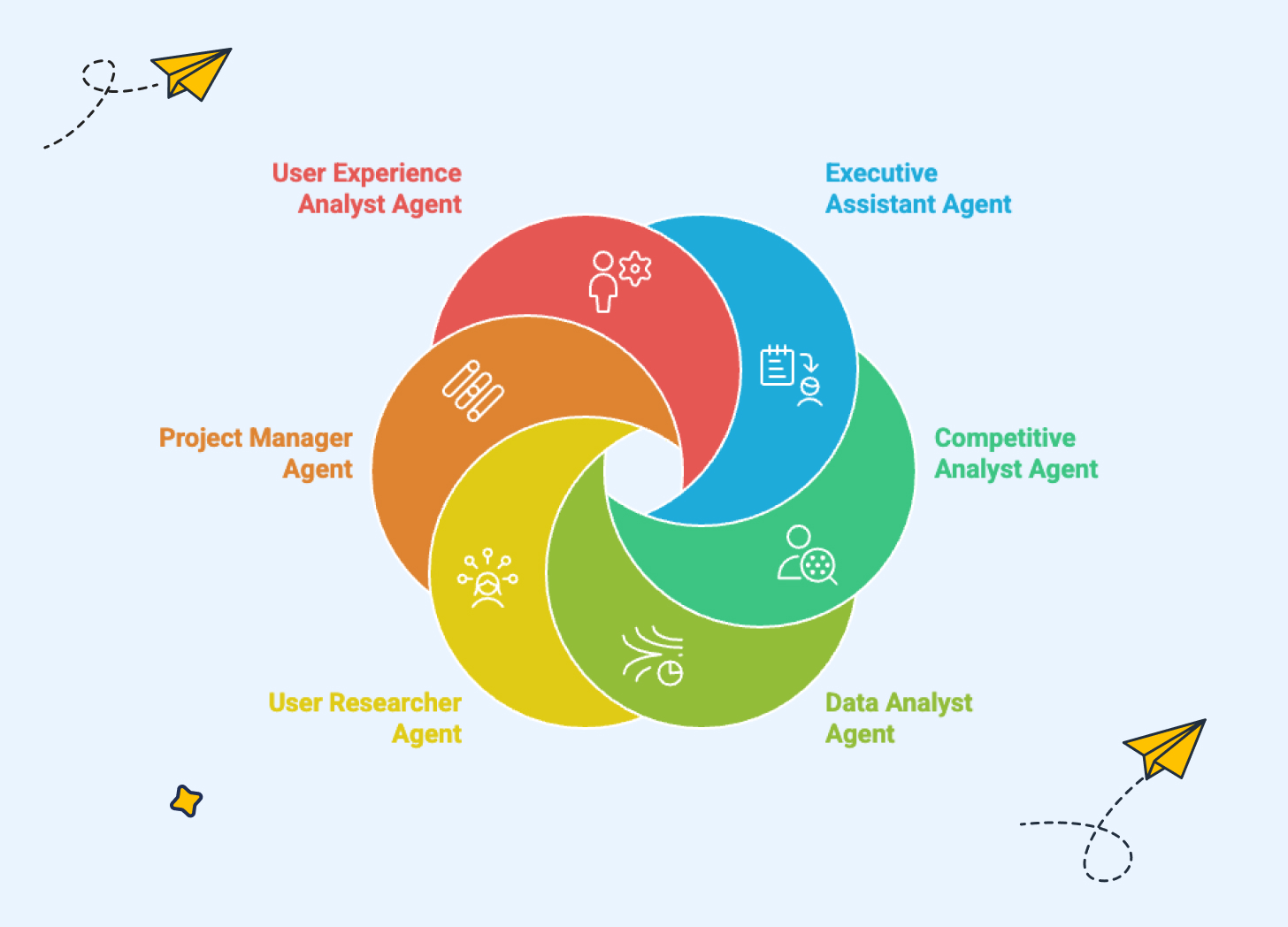
Table of contents
6 AI agents every product manager needs to “hire”
"Stop thinking about AI as a tool. Start thinking about it as a teammate you're hiring."
That’s something Jacob Bank, CEO of Relay.app, said at the AI Product Leaders Summit that made everyone in the room stop taking notes.
Jacob's the and he's spent the last two years helping product teams build AI agents that actually work. Not the science fiction kind. The kind that handles your meeting follow-ups, tracks competitor pricing, and analyzes user sessions while you sleep.
The difference? Most PMs are still using AI like a fancy calculator—ask it a question, get an answer, move on. But the PMs who are winning right now? They're delegating entire job functions to AI agents that work autonomously.
Today, I'm breaking down the six agents Jacob recommends every PM should "hire," plus the dead-simple framework for building them yourself.
Let's dig in!
What actually IS an AI agent?
Before we talk about which agents to hire, let's get clear on what we're talking about. Because most people confuse agents with copilots, and the difference matters.
Copilot: AI that lives within another tool and assists you in completing tasks.
Agent: AI that works on your behalf on its own.
Think of it this way: A copilot is like having someone sit next to you while you drive, offering suggestions. An agent is like having someone take the wheel for specific routes you've mapped out.
Jacob puts it perfectly:
"Think of an AI agent as a teammate, an employee, an intern, or a contractor that you're hiring. It's fundamentally different from traditional tools because it can carry out tasks independently once it's given clear instructions."
The 3 characteristics of effective AI agents (and really, any good teammate):
- Proactive - AI should wake up on its own to do work
- Integrated - AI should directly take action in your tools
- Repeated - AI will do the task many times and learn to do it better
That last one is key. You're not building a one-off automation. You're training a team member who gets better with repetition.
The AI agent job description framework
Here's where Jacob's approach gets brilliant. He treats building an AI agent exactly like hiring a human employee—you start with a job description.
"Think about how you can encode that in a four or five-sentence job description, and then build a set of task-specific agents that can do those tasks."
The framework has three components:
What: The work the agent should do
When: When they should do it
How: How they should do it (which tools, what format, etc.)
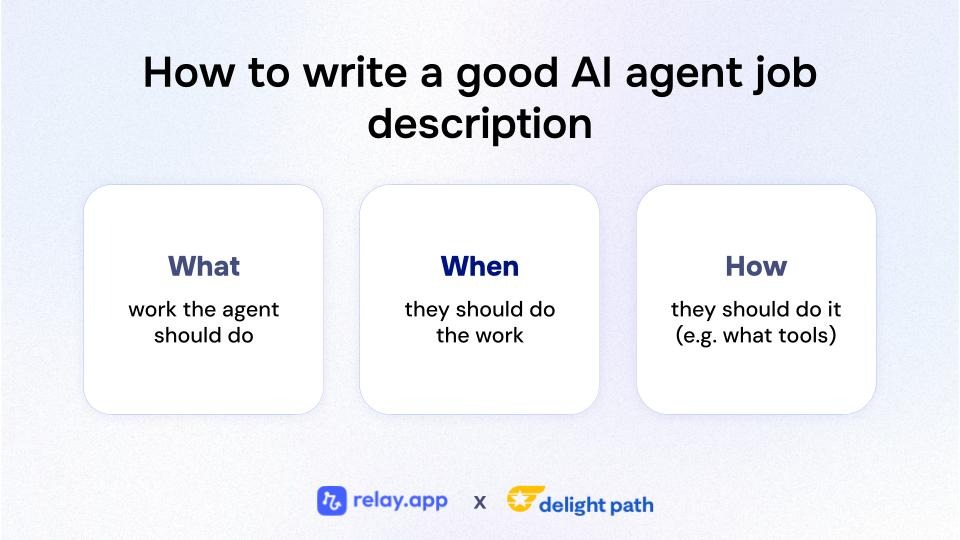
Example job description: Follow up after meetings: When a meeting ends, use AI to review the transcript and draft a follow-up email.
That's it. Clear, specific, actionable.
Two critical principles from Jacob:
- Don't try to build the perfect AI agent right off the bat. Instead, implement one simple task and incrementally add capabilities as you see results.
- If the AI is good and it's low stakes, let the AI agent run. But if it's high stakes or there's uncertainty about the AI's performance, make sure a human remains in the loop.
The psychology here is crucial. We tend to overthink delegation—whether to humans or AI. We imagine every edge case, every potential failure. But the best leaders (and the best AI implementers) start small, validate, then scale.
The 6 essential AI agents for product managers
Alright, let's talk about the actual team you should be building. Each of these agents handles work that's critical but time-consuming—the kind of stuff that keeps PMs tactical when they should be strategic.
1) Executive Assistant Agent
This is your leverage multiplier. The agent who gives you back hours every week.
Key responsibilities:
- Triage emails - When I receive an email, analyze whether I need to reply and label it accordingly.
- Meeting briefings - 30 minutes before each meeting, research the guests and send me a dossier.
- Meeting follow-ups - After each meeting, draft a follow-up email based on the transcript.
- Task reminders - Every day, identify tasks I've missed and remind me via Slack.

The meeting briefings are the game-changer here. Imagine walking into every customer call already knowing their company size, recent product launches, and key challenges. That's not just efficiency—that's showing up as a more strategic partner.
2) Competitive Analyst Agent
Most PMs do competitive research quarterly, maybe monthly. This agent does it continuously.
Key responsibilities:
- Track competitor pricing - Every month, check competitor websites and analyze price changes.
- Summarize competitor launches - Every week, look for major launches by competitors and summarize them.
- Research competitor reviews - Every week, scan sites like G2 and Reddit and synthesize review content.
- Analyze target customers - Every month, scan competitors' websites for reference customers and case studies.
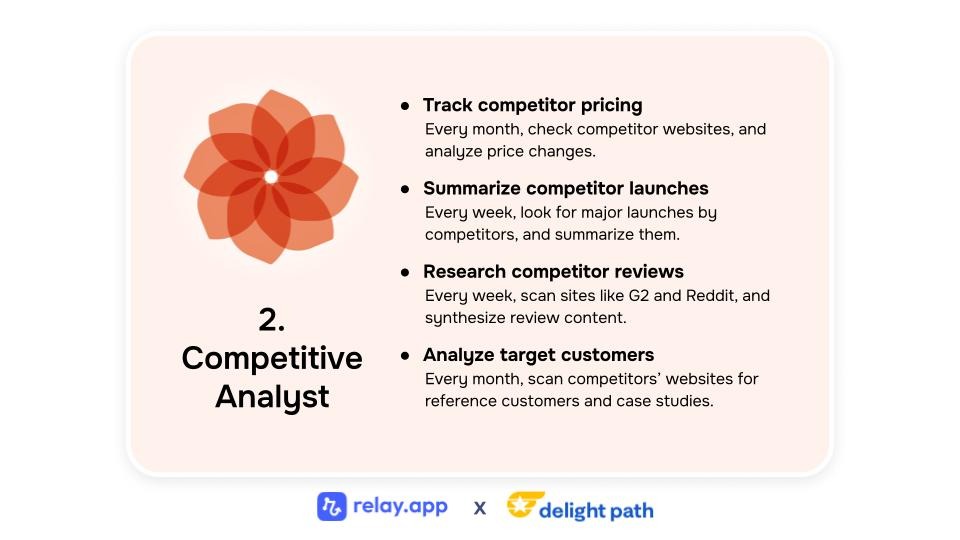
The Reddit and G2 scanning is where this gets powerful. You're not just tracking what competitors say about themselves—you're tracking what their customers are saying about them. That's intelligence most product teams miss entirely.
3) Data Analyst Agent
Here's the shift: metrics stop being something you check and start being something that alerts you.
Key responsibilities:
- Metrics reports - Every week, review key metrics and draft a summary.
- Metric alerts - Every day, check for important changes in key metrics.
- Benchmark research - Every month, compare our metrics to the latest benchmarks in our category.
- Customer profiling - Every month, review all of our customers and write a report on size, industry, etc.

The benchmark research is particularly valuable. Instead of you manually searching for "SaaS activation benchmarks" every quarter, your agent proactively compares your performance to industry standards and flags when you're falling behind or pulling ahead.
4) User Researcher Agent
This agent closes the "voice of customer" gap that kills most product decisions.
Key responsibilities:
- Synthesize support tickets - Every week, scan all new support tickets to uncover usability issues.
- Summarize online posts - Every day, scan online forums for quotes about our product.
- Analyze user interviews - Every week, review all customer interviews and write a report.
- Review product proposals: For every new feature spec, provide a user perspective in your comments.
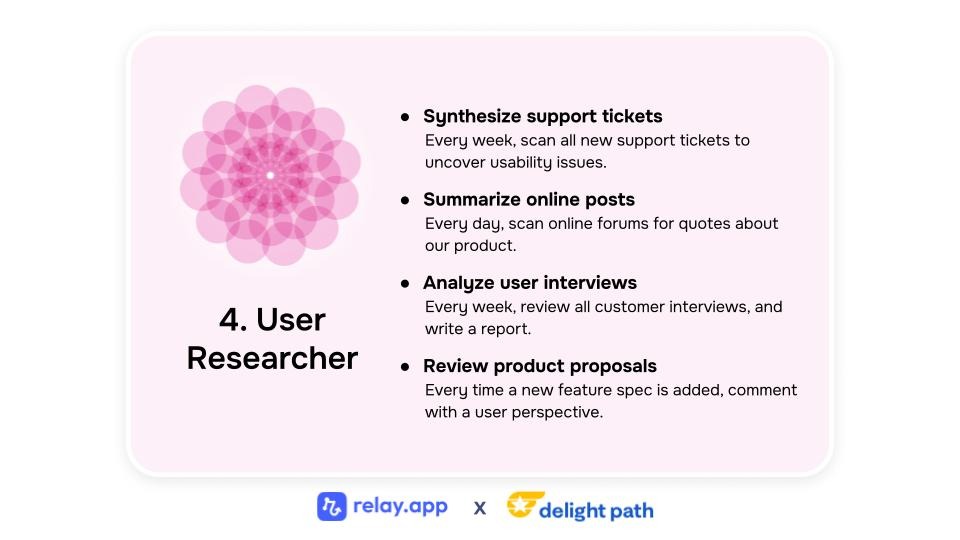
That last one is innovative. Imagine every spec getting an automated "here's what users have said about this problem" comment before you even schedule the kickoff meeting. You're baking customer insight into the process, not bolting it on afterward.
5) Project Manager Agent
This agent handles the administrative burden that keeps PMs from thinking strategically.
Key responsibilities:
- Project status reports - Every week, look at project status and send out a summary.
- Bug hygiene - When an important issue is overdue, notify the assignee.
- Action item follow-up - After each meeting, log action items and follow up until done.
- Burndown charts and analytics - Every week, analyze project progress and create appropriate charts and graphs.
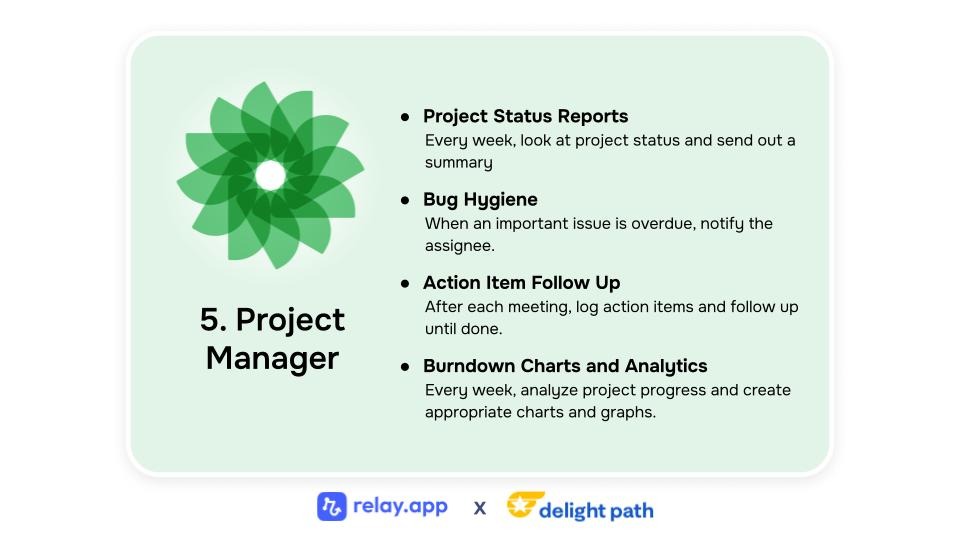
The action item follow-up creates accountability without you becoming the nag. The agent tracks commitments, sends reminders, and escalates when things slip. You get to focus on removing blockers, not tracking status.
6) User Experience Analyst Agent
This is where AI agents get truly powerful. This agent does analysis that would be impossible for a human to do at scale.
Jacob describes it perfectly:
"One example in our organization is an agent that analyzes session replays daily to understand user engagement with product features. It's like having an intelligent analyst who identifies patterns autonomously."
- Key responsibilities:
- Daily session replay analysis - Every day, review new session recordings and identify friction patterns.
- Feature engagement tracking - Every week, analyze how users interact with recently launched features.
- Abandonment pattern detection - When users consistently drop off at specific points, flag for investigation.
- Cross-feature usage analysis - Every month, identify which feature combinations lead to the highest retention.

Think about what this means: Instead of you manually watching 10-20 session replays when you have time, an agent watches hundreds daily and surfaces only the patterns that matter. You're getting user insight at a scale that was previously impossible.
How to build AI agents
Here's the good news: You don't need to be a developer to build these agents.
The three-step process:
Step 1: Choose one task from one agent above. Start with something low-stakes but valuable (meeting follow-ups are a great starter).
Step 2: Use a tool like Relay.app to create a workflow. Describe the task to the AI assistant in plain English using the What/When/How framework.
Step 3: Test the workflow with real data. Refine the instructions. Turn it on and let it run.
The key insight from Jacob: "Implement one simple task and incrementally add capabilities as you see results."
Don't try to build all six agents in week one. Pick the one that would save you the most time or give you the most strategic advantage. Get it working. Then add the next one.
From tactical to strategic
Here's what this is really about: PMs are supposed to be strategic thinkers, but most spend 80% of their time on tactical execution. These six agents flip that ratio.
They handle the continuous monitoring, the routine analysis, the administrative follow-up. You get to focus on the decisions that only you can make—the product strategy, the customer insights, the team development.
Jacob Bank isn't selling science fiction. He's describing what's already working for product teams. The question isn't whether AI agents can handle these tasks. The question is: What will you do with the 10-15 hours per week they give you back?



Related Posts